AI Industry Map
24 AI supply-chain layers · 16 public-equity covered · 3 private-market · 5 classification-only.
Descriptive positioning only. The positioning label says whether a company's business is exposed to a layer, never whether to buy it. Layers with no exposure are not recommendations to add any.
1AI Energy
2Semiconductor Materials & Equipment
Semiconductor Materials
Silicon wafers, photoresist, specialty gases, and process chemicals — few suppliers per node.
Foundry
Contract wafer fabrication and advanced packaging that turn accelerator designs into silicon.
Semiconductor Equipment
Lithography, etch, deposition, inspection, and advanced packaging tools.
3Compute & Memory
Compute
GPUs, AI accelerators, and general-purpose compute silicon for training and inference.
Custom Silicon
ASICs and custom accelerator designs (in-house or merchant silicon) for specific AI workloads.
HBM / Memory
HBM/DRAM bandwidth beside accelerators, plus enterprise NAND/HDD capacity. US-listed tickers or ADRs only.
4Networking & Optical
5Power & Cooling
6Data Center & GPU Cloud
AI Server
GPU servers, racks, and storage systems integrating accelerators into deployable units.
Data Center
Hyperscale and colocation facilities, datacenter REITs, and the construction that builds them.
Cloud
Hyperscale cloud platforms renting general compute, storage, and managed services.
GPU Cloud
Accelerator rental: neoclouds, sovereign AI compute, and enterprise private GPU clusters.
7Data & Model Infrastructure
AI Infrastructure Software
GPU runtimes, training frameworks, orchestration, and inference serving.
Foundation Model
Frontier and open models across text, vision, audio, and reasoning; revenue is token-metered.
AI Data
Pipelines, embeddings, vector stores, retrieval, labeling, and synthetic data.
AI Platform
MLOps/LLMOps, model gateways, evaluation, and deployment tooling.
8Agent & Security
9Enterprise & Vertical AI
10Physical AI
How demand propagates (optional diagram)
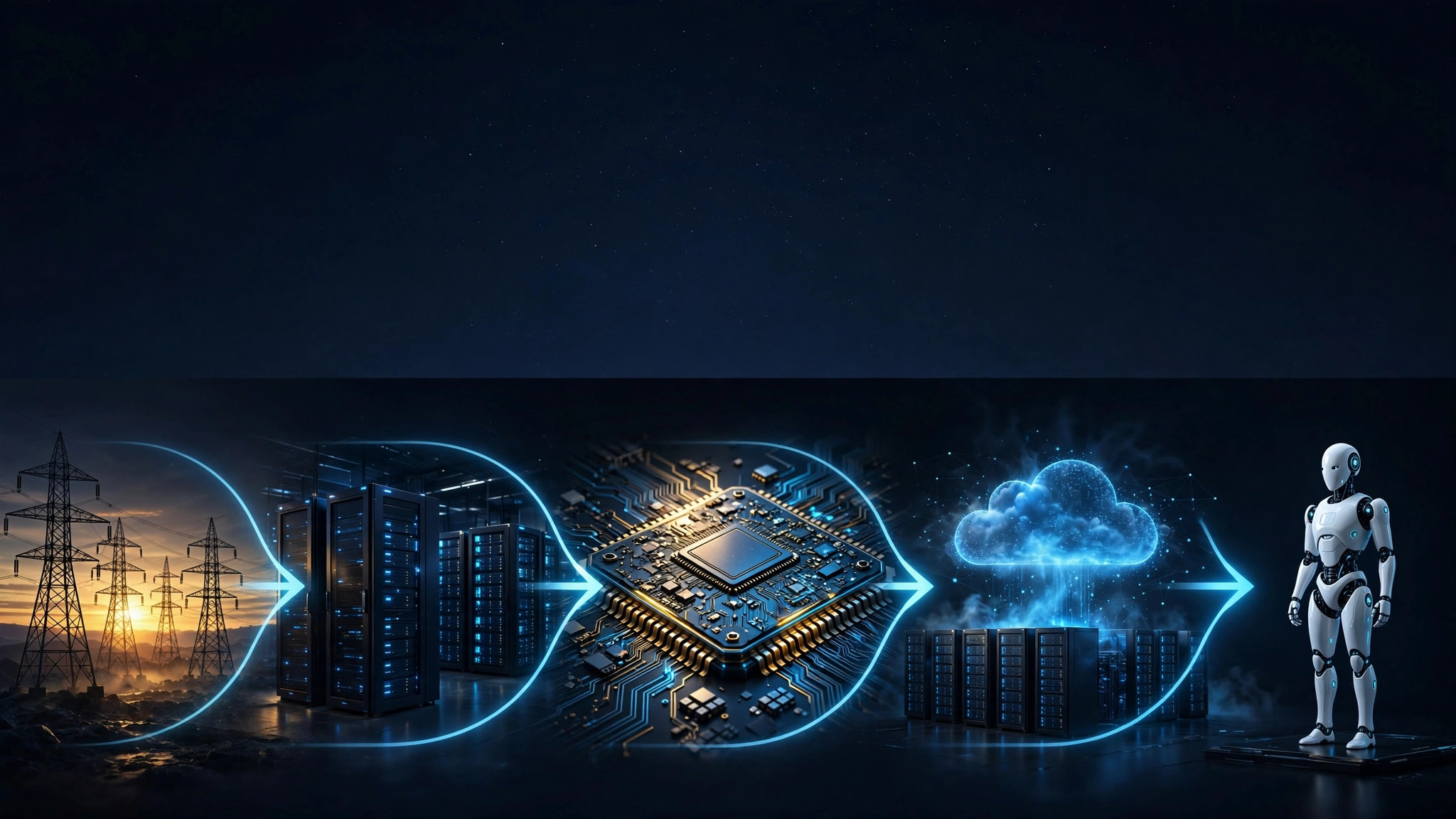
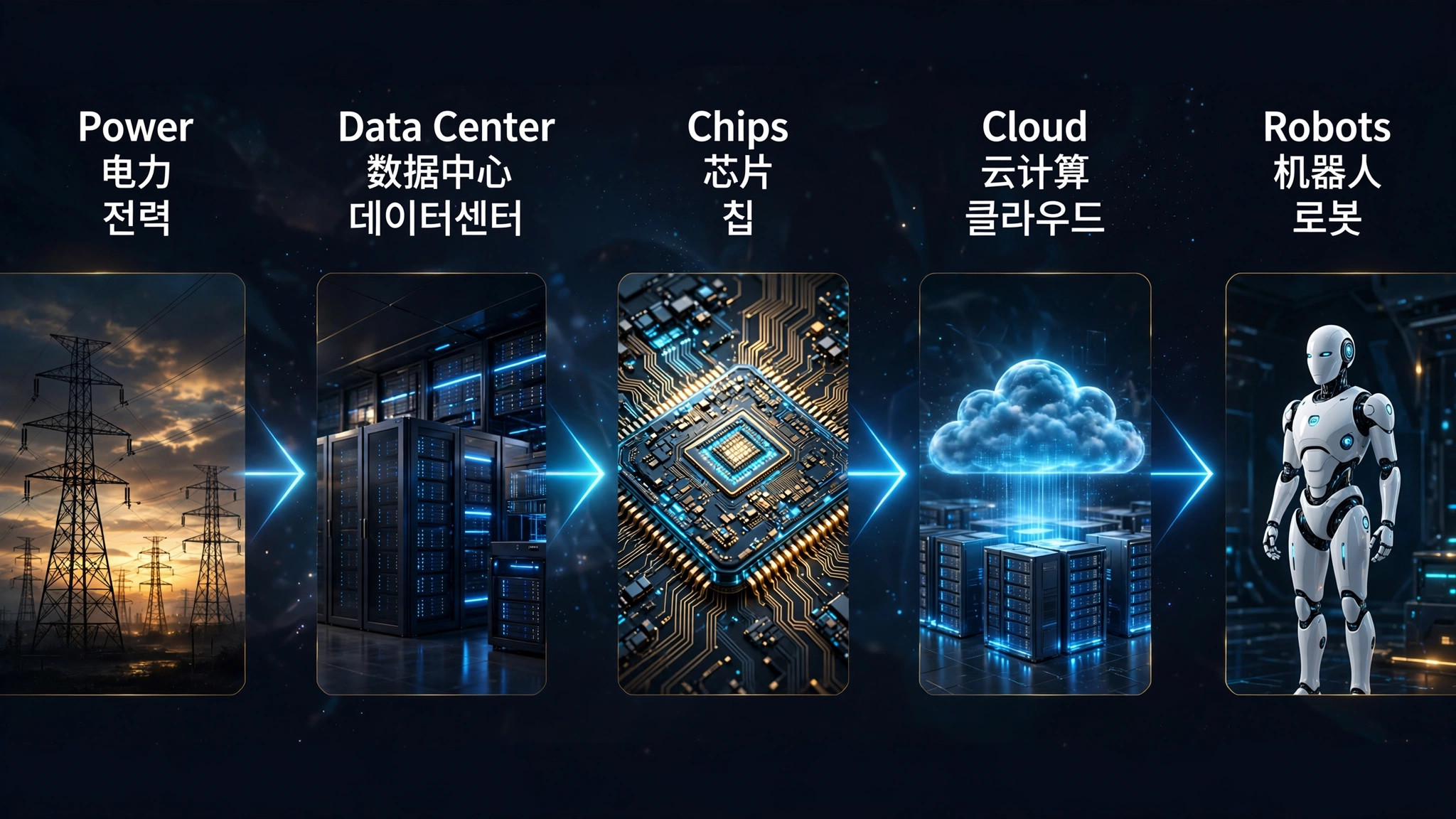
Most AI investing stops at the visible end — a GPU designer and a chatbot. The chain runs much further in both directions. 24 AI supply-chain layers in 10 tracks: 16 with public-equity companies named, 3 private-market (pure plays not listed), 5 classification-only (we will not publish a contestable ticker list as fact). Empty does not mean unresearched.
- AI demand
- More accelerators
- More HBM → advanced packaging → wafers → equipment → materials
- More interconnect and optics
- More racks → power → cooling
- More datacenter capacity → rentable compute
- More models, data and agents
- More enterprise, vertical and physical applications
Common questions
What is the AI Industry Map?
It splits the AI supply chain into 24 layers across 10 tracks, from energy and materials through chips, networking, power, cloud and applications. Each layer names companies whose primary business sits there, with a public source and a checked-on date. It is research context, not a buy list.
Does being on the map mean a stock is recommended?
No. Layer placement is XingAI's own taxonomy, not a rating or ranking, and the filers did not endorse it. Companies that span several constraints appear on more than one layer. Nothing here is a price target or investment advice. Each company role links a public source.
Where do the fund holdings on the map come from?
From public SEC Form 13F-HR filings, which are lagged, long-only US equity reports filed after quarter-end. A listed position may already have been sold. Each company role links its public source with the date it was checked. It is research context, not a current holdings book.